

Executive Summary: The Bundesliga's Strategic Pivot
The Bundesliga's latest UK media rights deal marks a profound shift in the sports broadcasting landscape.
This arrangement is a multi-layered strategic architecture designed to optimize for reach, revenue, and brand relevancy.
By unbundling its rights and distributing them across a diverse array of platforms—including traditional broadcast, subscription streaming, pay-per-view, and digital creators—the German league is proactively addressing the challenges of a fragmented media environment.
It is either brilliant in hindsight or a forced play due to diminishing broadcast rights.
Sports Perfect Storm.
A central and radical component of this strategy is the inclusion of YouTube content creators, which, while not the first time a creator has been involved in sports rights, represents the first time a major European football league has awarded an extensive package of live games to digital influencers.
This move signifies a departure from a sole focus on securing the highest possible rights fee, instead betting on the long-term value of a broader, younger, and more engaged fanbase.
The financial return is expected to be indirect, stemming from an increase in brand profile, merchandise sales, and the monetization of a new, data-rich audience.
This blueprint serves as a viable model for leagues aiming to grow their international presence. It demonstrates a sophisticated understanding, or at least a desire to have, of modern fan patterns which increasingly leans towards on-demand and social media content over traditional television.
Hence reduced broadcast dollars.
Eyeballs are shrinking, spending billions of hours on Youtube, Tiktok, Roblox and more.
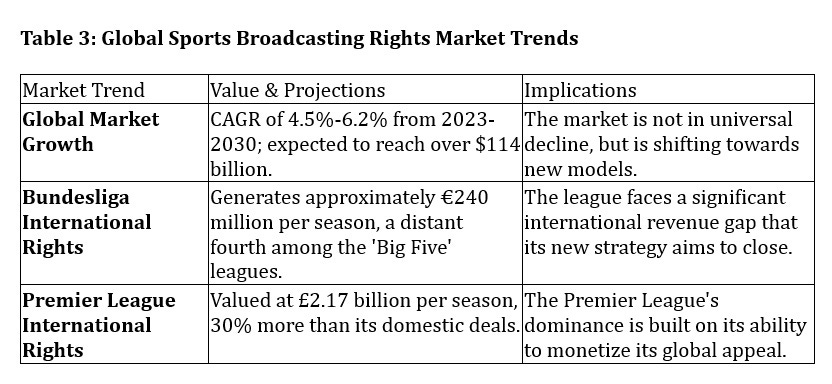
The Bundesliga's approach is a calculated response to its persistent international revenue gap, which places it a distant fourth among Europe's top five leagues.
This is not a concession to a declining market but perhaps a calculated move to capture a larger share of a growing global market, effectively trading a large, exclusive rights fee for direct access to new audiences.
1. The New Bundesliga UK Rights Deal: A Multi-Platform Architecture
The new Bundesliga broadcast deal in the UK will be a blueprint for other sports orgs in media rights fragmentation.
Rather than entrusting its product to a single broadcaster, the league has meticulously divided its content into distinct packages, each tailored to a specific audience segment and business model.
The result is a multi-layered distribution strategy that maximizes the league’s footprint and a core goal of boosting its profile in a difficult market.
1.1. The Unbundling of Rights: A New-Look Lineup of Partners
The deal's structure is defined by its diverse set of partners.
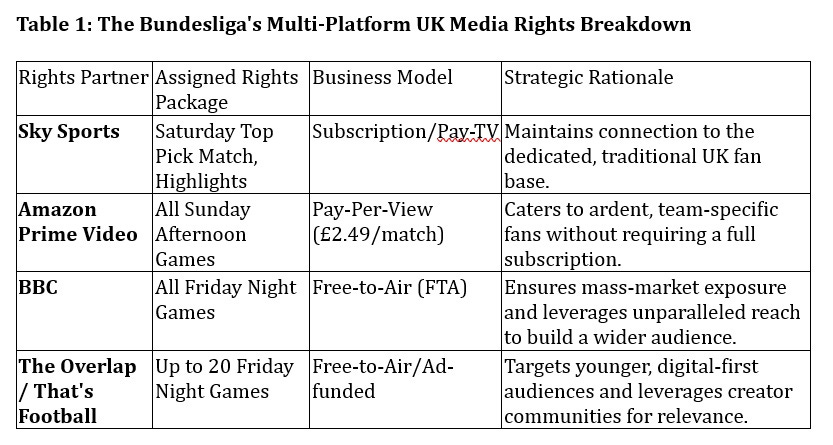
Sky Sports, the incumbent rights holder, maintains its relationship with the league by retaining the flagship Saturday evening "top pick" match. This package also includes a highlights show and various shoulder programming.
This component ensures the Bundesliga retains its presence on the most prominent pay-TV platform in the UK, maintaining access to the country's most dedicated football fans.
Amazon Prime Video has secured exclusive rights to all Sunday afternoon games, which will be offered on a pay-per-view (PPV) basis for £2.49 per match.
This model caters to the most ardent supporters who are willing to pay for individual matches of their teams without committing to a full subscription.
The BBC will stream all Friday night games for free on its BBC iPlayer and BBC Sport app. This free-to-air (FTA) component is central to a broader strategy of liberalisation and provides mass-market exposure, leveraging the BBC's reach to build a wider audience base.
The most radical element of the deal involves the inclusion of two prominent YouTube channels,
The Overlap (with 1.5 million subscribers) and Mark Goldbridge's That's Football (with 1.4 million subscribers).
These creators have been granted the rights to air up to 20 Friday night matches in a "watch-along" format, running simultaneously with the BBC's broadcast. This innovative partnership is a direct acknowledgment of the growing influence of digital influencers and a proactive effort to engage new fans who may not consume live football on traditional television.
1.2. The Strategic Rationale: A Multi-Layered Approach for 'Reach, Revenue, and Relevancy'
The rationale behind this complex arrangement is the Bundesliga's pursuit of a multi-platform strategy that aims to deliver the optimal value of reach, revenue and relevancy.
The league's international revenue has historically lagged significantly behind other major European leagues, generating a distant fourth among the "Big Five".
This strategy is designed to close that financial gap by building a wider international fanbase creating revenue waterfalls from other streams as awareness increases.
More eyeballs on the sports is the top of the funnel.
The UK, a mature and competitive football market, is a prime target for this model.
The decision to fragment the rights, rather than selling them to a single bidder, is a deliberate choice to avoid the high cost of an exclusive, all-in-one deal that might not deliver the desired return.
This multi-layered approach is a strategic campaign tailored to a specific under-indexed market. The league is not just broadcasting games; it is using a variety of access points to reach different fan segments.
Sky serves the existing hardcore audience, Amazon's PPV model targets the loyal, paying sub-segment, and the free-to-air BBC and YouTube channels act as a brand-building tool and a loss-leader for mass awareness.
The creators, in particular, serve to attract a younger audience that is more interested in the Premier League or Serie A, leveraging their unique style and community to market the Bundesliga.
2. The Creator Economy in Sports: From Watch-Alongs to a New Era of Fandom
The Bundesliga's deal with YouTube creators represents a new stage in a progressive evolution of sports media partnerships.
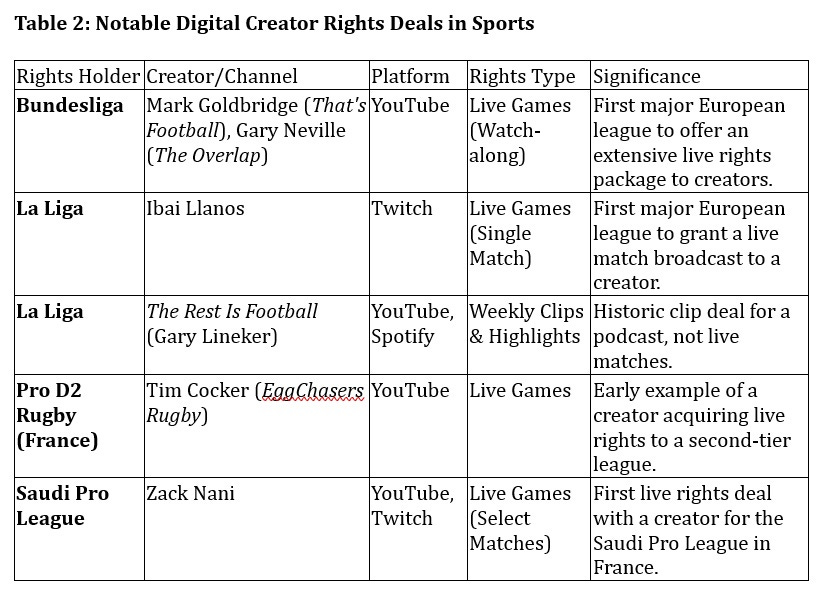
The first true live sports broadcast rights deal with a major digital creator was a watershed moment for Spain, where Twitch streamer Ibai Llanos live-streamed a La Liga match in 2021.
This move, which was repeated for the Copa America tournament, demonstrated the immense viewership potential of creators, with Ibai breaking records and attracting over 10.8 million viewers for a separate boxing event.
Other precedents include the EggChasers Rugby podcast's acquisition of French rugby rights and streamer Zack Nani's deal for the Saudi Pro League. These examples illustrate that the Bundesliga's move, while significant, is part of a broader, accelerating trend.
The French Rugby Blueprint: EggChasers Rugby and the Pro D2
An earlier example of a live sports rights deal with a creator is the partnership between the French rugby second-tier competition, Pro D2, and the EggChasers Rugby podcast.
Tim Cocker, a co-host of the podcast, secured the UK and Ireland streaming rights for the league. Games are streamed for free on the FR-UK Rugby channel on YouTube, with plans to show 35 games next season. Cocker, a former rugby reporter for BT Sport, expressed a strong belief in the platform, citing that demand for rugby content outstrips the supply on YouTube.
The deal, which took a year of talks to finalize, was seen as a way to attract fans who would not normally pay for expensive rugby subscriptions.
Zack Nani and the Saudi Pro League
Another recent and significant deal was made by French streamer Zack Nani, who acquired the broadcast rights for select Saudi Pro League matches in France.
The agreement allows Nani to show up to three games per week, with an obligation to air at least one per matchday, on his YouTube and Twitch channels.
The cost of the deal was described as six figures plus in euros, and it gives him exclusivity on the free-to-air segment of the market.
The opportunity arose after Canal+ declined to renew its rights, and other major broadcasters showed limited interest.
For the Saudi Pro League, this partnership represents a way to directly connect with a younger, digitally engaged, French-speaking audience at a time when the league is seeking to expand its global reach.
2.2. The Business of "Watch-Alongs": The Value of Mark Goldbridge and Gary Neville
The Bundesliga deal with Mark Goldbridge and Gary Neville's The Overlap is progressive because it involves a live "watch-along" format.
This approach is not a simple re-broadcast with commentary; it is a co-production where the league provides the live feed, and the creator provides a unique and authentic broadcast experience to their established community.
Both channels have significant subscriber bases, making them powerful partners for reaching new audiences.
The critical distinction between a "clips" deal and a "live rights" deal with a creator is rooted in the purpose of the partnership.
A highlight deal primarily serves to leverage a league's existing product for increased visibility and brand awareness while a live rights deal, however, is a deeper collaboration where the league effectively outsources fan engagement to a figure who has already built a trusted and highly-engaged community.
This strategy allows the league to bypass the challenge of attracting new fans through traditional, one-way media and instead engage them through a more personal, interactive, and community-centric experience.
This opens the doors for more personal experiences, including web3 and AI.
The league recognizes that these creators attract "sizeable but very different audiences" that are difficult to reach through conventional channels.
By partnering with them, the Bundesliga gains access to these coveted demographics and leverages the creator's personality to forge a new connection with potential fans.
3. The Economics of Eyeballs: Monetization and the Strategic Value of Reach
The value of this deal, with no financial details forthcoming aim for a long-term, multi-pronged approach.
The monetization for the creator channels themselves comes from two primary sources: ad-revenue sharing and brand sponsorships.
Ad-revenue sharing, which is a key component of YouTube's business model, varies widely based on factors such as a channel's niche and audience demographics but is a hugely underrated and underused revenue stream for sports.
Sponsorships are also a significant source of income, with rates for large channels like
The Overlap and That's Football potentially ranging from thousands to tens of thousands of dollars per video.
The return for the Bundesliga is not an immediate, direct payment but a strategic investment in audience acquisition. By providing its product at low or no cost to the creators, the league is using the free-to-air broadcast to draw in new, younger fans who would otherwise be difficult to reach or ignore traditional entry points.
These new fans can then be monetized in a variety of ways. They might be converted into paying customers for Amazon's PPV games later in the season, or their increased engagement could lead to greater merchandise sales, sponsorship value, and broader brand awareness for the league.
3.2. The Reach-to-Revenue Equation: An Indirect Path to Profitability
The core of this strategy lies in the shift from a direct rights fee model to an ecosystem-based monetization approach.
A traditional rights fee is a single transaction where a league sells its product to a broadcaster for a fixed price.
The new model is a collaborative partnership. By granting free-to-air rights, the Bundesliga gains the ability to capture valuable fan data from a wider audience = although the mechanism or tech around this has not been discussed.
This data if grabbed and used the right way will be a valuable asset that can be used to inform marketing strategies, deepen customer relationships, and be monetized in the long run.
The Bundesliga's approach aligns with the broader trend of leagues exploring new ways to turn content chaos into commercial value by creating sponsor-ready, revenue-generating assets from everyday content.
This is a data led approach that, in the long term, can more than offset forgone rights revenue by creating new revenue streams through a deeper understanding of the fan base.
For leagues, the new reality is that the value is not in the initial transaction but in the ongoing relationship with the fan, which can be cultivated most effectively on platforms where the audience is already engaged.
The nice Pandora’s Box for sports, the capture of the fan engagement across all platforms unlocks multiple revenue streams.

4. The Macro-Landscape: Broader Market Trends and the Future of Sports Rights
To understand the Bundesliga's actions, it is essential to situate them within the broader trends of the global sports media market. The league's strategy is not a reaction to a market in decline but a calculated response to a market in flux.
4.1. The "Uncertainty" Era: The Plateaus and the Growth
The global sports broadcasting rights market is not shrinking; it is projected to grow at a compound annual growth rate (CAGR) of 4.5% to 6.2% from 2023 to 2030, reaching a market value of over $114 billion.
However, this growth is not uniform, and some domestic deals are experiencing a plateau or even a push for lower fees, as evidenced by ESPN's reported desire to reduce its annual MLB rights fee to a third of its previous value.
This variability is largely due to the decline of the traditional Regional Sports Network (RSN) model, which relied on bundled cable subscriptions.
As cord-cutting accelerates, leagues are no longer guaranteed a captive audience and are being forced to adapt their strategies. This has led to an increasing number of leagues and teams exploring alternative distribution methods, such as direct-to-consumer (DTC) streaming services and Over-the-Air (OTA) broadcasts.
4.2. The Expert Perspective: The Future is "Platform-Agnostic"
The new reality for sports media is about meeting fans where they are, not where you want them to be.
Experts like Jo Redfern, who specializes in digital strategies, view YouTube as the future of sports media consumption for future generations due to its creator-led format and unparalleled reach.
She notes that YouTube provides an extraordinary content spectrum that redefines the very idea of a sports broadcast.
It is the definition of sticky, a platforms dream.
This perspective aligns with the Bundesliga's platform-agnostic approach. By unbundling its rights and distributing them to a diverse set of partners, the league is creating a comprehensive hybrid approach that covers all bases.
This strategy maintains a presence on linear TV for legacy fans, offers a premium PPV option for hardcore followers, and uses a free-to-air digital strategy to capture the next generation of fans
The fragmentation of the market is not seen as a weakness but as a strategic tool to build a more resilient and future-proof business model. It positions the league for long-term growth by solving the two-pronged problem of declining traditional viewership and a persistent international revenue gap.
5. Strategic Outlook and Recommendations
The Bundesliga's UK deal is a bold experiment with significant implications for the future of sports media. However, this blueprint comes with inherent trade-offs and challenges that must be addressed for it to succeed.
5.1. Trade-Offs and Challenges of the Blueprint
A primary challenge of this fragmented model is the risk of alienating fans.
The need for multiple subscriptions and devices to follow a single league can be frustrating and could potentially lead to subscription fatigueor a breakdown in fan loyalty.
The deal likely involves a short-term trade-off where the league forgoes a large, exclusive rights fee in exchange for the long-term potential of audience growth.
This is a strategic bet that may not pay off immediately, hence the reason for slow uptake from sports as they are wielded onto the idea that broadcast contracts keep the lights on.
They are flickering.
The shift to a digital-first approach also brings new challenges related to content consumption, as the "snack culture" of short-form videos on platforms like YouTube contrasts with the traditional long-form narrative of a live match.
5.2. Recommendations for Leagues and Creators
For Leagues:
Audience Segmentation: Leagues should identify under-indexed markets where a similar model can be deployed to build a fanbase. The UK is a test case, and a successful outcome could justify similar strategies elsewhere to expand the league's global footprint.
Data is Gold: A successful multi-platform strategy relies on a robust data collection and analytics infrastructure to effectively monetize the new, free-to-air audience. Leagues must invest in technologies that allow them to understand and serve these new fan segments, leveraging this data to drive future revenue.
Empower Creators: The value of a creator is not just in their subscriber count but in their unique style and community engagement.18 Leagues must treat creators as collaborative partners who add value, not just as new distribution channels. The Bundesliga's model of providing a live feed for a "watch-along" is an excellent example of this collaboration.
For Creators:
Build Community: Creators are valuable to leagues because of the communities they have built. The value is not just in the size of the channel but in the level of engagement, which can be measured through comments, watch time, and other metrics.
Diversify Content: While the live game is the foundation of the partnership, the research indicates that fans also demand on-demand highlights, analyses, and other supplementary content. Creators should build a full content ecosystem around their live broadcasts to retain and grow their audience.
Leverage Cross-Platform Influence: A strong presence on other platforms, such as TikTok, Instagram, and podcasts, can significantly increase a creator's value and their ability to secure lucrative sponsorships. This cross-platform influence demonstrates a creator's ability to reach and engage a wider audience beyond a single platform.
A very intelligent and readable analysis, thank you.
In the long term, it's hard not to see the "Saturday night Sky game" being the thing that gets squeezed.
If you're a neutral or loyal fan, it's easy to see how "season ticket" style deals could be incorporated into the PPV model to add value to fans. But paying a premium for a Saturday night game is increasingly going to look poor value, and I imagine most fans will choose piracy over an expensive subscription where they're paying for loads of content they don't want.